Mexico’s economy is showing signs of strengthening after disappointing early this year and inflation has passed its peak, said central bank Governor Agustin Carstens.Read about the economic policies and other platforms being carried out by Mexican President Enrique Peña Nieto from the presidential website.
Increasing exports and government spending will help reactivate an economy that has already seen improved consumer confidence, Carstens told the Senate in Mexico City. After climbing to an eight-month high of 4.48 percent in January following a tax increase, inflation slowed to a “suitable zone” at 3.89 percent in the first half of March, he said.
Image Source: www.newamericamedia.org
“In the latest figures we’ve seen much more clearly a reactivation” in the economy, Carstens said. “We think the convergence of inflation to our 3 percent objective will happen very quickly next year” as gasoline price increases are pegged to the broader inflation, he said.
Image Source: blog.gasbuddy.com
Banco de Mexico forecasts the economy will expand 3 percent to 4 percent this year, rebounding from 1.1 percent growth last year that was the lowest since the 2009 recession. Carstens said the bank will review its forecasts and economic data in preparing its first-quarter inflation report.
Image Source: www.flickriver.com
The consumer confidence index rose to 88.8 in March from 84.5 the month earlier, the national statistics agency reported on its website today.
Thursday, April 10, 2014
REPOST: Mexico Economy Recovering With Inflation Easing, Carstens Says
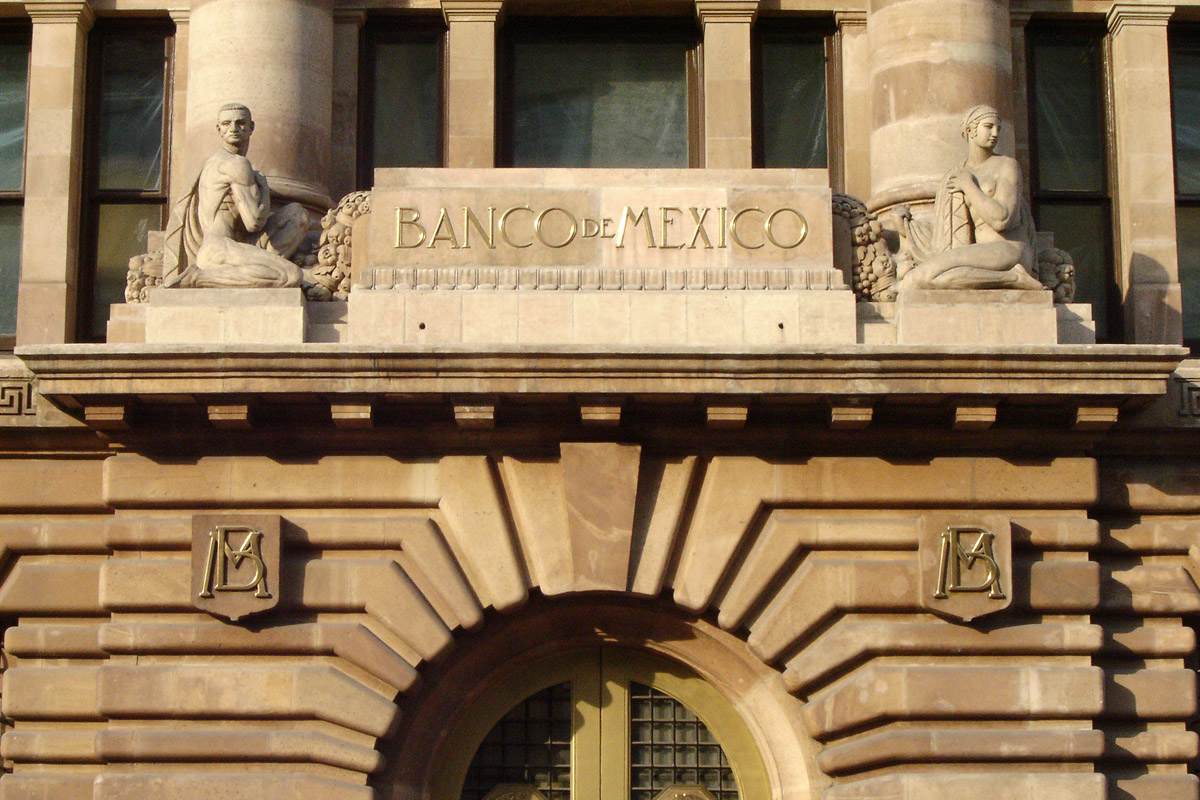
Bloomberg’s Eric Martin reports that, with inflation rates easing up since peaking in early 2014, the Mexican economy can resume its track toward continued growth.



Saturday, March 15, 2014
REPOST: How El Chapo Arrest Will Affect Mexican Economy; Tourism And Foreign Investment Expected To Increase
The capture of the notorious criminal El Chapo is set to create a positive ripple effect in the Mexican economy, reports Patricia Rey Mallén of the International Business Times. More details below.
Image Source: www.ibtimes.com

For more updates on the administration goals of President Enrique Peña Nieto regarding the economy of Mexico, visit the presidential website.MEXICO CITY -- The arrest of drug lord Joaquín Guzmán Loera, “El Chapo,” the most wanted criminal in the world, has set Mexico into a frenzy. The capture, the outcome of a joint operation of U.S. and Mexican forces, brought warnings of caution that the war on drugs is certainly not over. But it also gave President Enrique Peña Nieto cause to celebrate a win against organized crime and a welcome boost for his administration.Indeed, the arrest marks an end to an era of criminal power in Mexico, and while it does not mean the end of the Sinaloa cartel, let alone drug trafficking in the country, it will left Mexico’s image, said Tourism Minister Claudia Ruiz Massieu.
“Just like any good news, this strengthens the vision that Mexico has a strong leadership in the president,” Ruiz said Monday at the opening of the XII National Tourism Forum in Mérida, Yucatan.
The ministry expects an investment of $1.4 billion in tourism in 2014 -- $100 million more than last year. Tourism makes up 9 percent of the country’s GDP.
This positive view is a change from the latest United Nations report in 2013, in which Mexico dropped in the ranking of popular vacation destinations, from 10 to 13 out of 50 countries listed. Last year was the first in five that Mexico had fallen out of the top 10, due mainly to drug-related violent crime and the global economic slump.
Not only tourism is expected to benefit from the arrest. Mexican entrepreneurs showed their enthusiasm at the prospect of a safer national environment, more focused on bringing in investment. Gerardo Gutiérrez Candiani, president of the Consejo Coordinador Empresarial (Entrepreneur Council, or CCE), said the arrest of El Chapo was “a show of strength from the government, and a decisive step toward a safer, fairer Mexico, a country ready for foreign investment.”
Mexican columnist Leo Zuckermann illustrated the change in attitude with an anecdote: Peña Nieto attended the recent World Economic Forum in Davos, Switzerland, for the first time. While he was deep into a passionate speech on the progress made by his administration on political and economic reforms, a member of the audience asked the Mexican president what his plans were to fight crime. Peña Nieto, visibly uncomfortable, was rendered mute by the question.
“It was obvious that foreign investors are still worried about violence, further than the political reforms. The capture of Chapo Guzmán is the answer to that question. It sends the message that this government is working to solve the problem of organized crime,” Zuckermann wrote.
Despite the trepidation voiced by some, investment in Mexico is at historical highs. The country drew a record $35.2 billion in foreign direct investment in 2013 – nearly double the level seen the previous year.
Right after Davos, three major companies announced major investments in the country. Pepsico (NYSE:PEP), Nestlé (VTX:NESN) and Cisco (NASDAQ:CSCO) will together invest over $7 billion in the country.
El Chapo Guzmán has already been taken to the top-security Altiplano prison, in the state of Mexico, where he awaits trial. The U.S. is asking for him to be extradited, but the Mexican ambassador to the U.S., Eduardo Medina Mora, said the drug lord should face the many charges against him in Mexico first.
Thursday, February 20, 2014
REPOST: For Mexico, Economic Growth Hinges on Justice
While prospects remain high for Mexico's economy, growth is not without its lingering obstacles. Viridiana Rios, contributor to Forbes.com, writes about how sweeping reforms of justice is in order to maximize its potentials for growth.
We thought these were the good times for Mexico, but its economic growth has fallen short of expectations, with estimated 2013 growth at 1.3 percent. Why has Mexico performed so poorly? A number of recent studies point to the presence of a poor justice system as a major contributing factor. Weak rule of law in Mexico has inhibited investors, who struggle to understand bankruptcy proceedings and lack confidence in the court’s ability to impose punishments on delinquent borrowers.
In order to pave the way for economic growth, Mexico must address four issues.First, its business community and entrepreneurs must be shielded against crime. A 2013 study by Tishay and Pearlman found that, due to high crime rates, Mexican entrepreneurs are less likely to plan expansionary business ventures, and firms pay quite high monetary costs in order to avoid crime. A 2010 study by the International Finance Corporation revealed that 42.8 percent of Mexico’s firms paid for private security, spending about 2.2 percent of their annual sales on these services. Extortion, which some studies show affects between 19 percent and 38 percent of Mexico’s middle class creates multi-million dollar losses which must be contained and treated as a national security problem. Furthermore, police must focus their efforts on reducing the theft of merchandise that occurs during transportation.
Second, Mexico must make sure that its justice system creates stability among economic actors. Confidence in the certainty of contract enforcement is a fundamental element in the healthy growth of the market system. According to a 2010 OECD study, “it takes 421 days and costs 20 percent of the contract value to enforce a contract in Mexico whereas it takes only 75 days and 5 percent of the contract value in Korea.”
To create a system where justice is predictable, Mexico must create a professional career service for prosecutors, public lawyers and local judges. As of now, prosecutors are appointed and removed at the discretion of the judge, they are underpaid and standardized procedures to evaluate them do not exist.
Third, Mexico needs to develop a legal system that encourages entrepreneurship and competition. The process of liberalizing Mexico’s economy resulted in extreme concentration of wealth and economic control. The design, approval, and implementation of antitrust law will be crucial for allowing smaller firms to thrive.
Finally, Mexico must enforce rules against economically damaging activities such as corruption, predatory behavior, and informality. According to The Economist, in 2010 Mexicans paid 32 billion pesos ($2.5 billion) in bribes. Corruption affects the economy by changing the country’s composition of capital inflows in a way that makes it more susceptible to a currency crisis triggered by a reversal of international capital flows (Wei and Wu 2002). Informality is also a major challenge for the economy. It is estimated that Mexico’s productivity would rise between 30 percent and 50 percent as a result of moving informal workers to the formal sector.
In Mexico, effective enforcement of laws targeting corruption, predatory behavior, and informality requires that innocent people are kept out of prison, and that the guilty pay a just penalty for their crimes. Only 57 percent of all inmates in Mexico have been sentenced, the rest (about 99 thousand) are still awaiting trial. As a result, Mexico spent $460 million dollars on keeping potentially innocent citizens imprisoned, in 2012 alone. Such resources could pay for the college education of around 184 thousand Mexican citizens.
These challenges are profound and diverse, but each presents an opportunity to apply the rule of law in such a way that encourages economic growth. Mexico’s moment will only become sustainable if both society and the economy become far more predictable and certain.
The presidency of Enrique Peña Nieto aims to make social reforms to stamp out crime at the grassroots level. Get updates on the president and his activities from the Mexican presidency's official website.
 |
| Image source: techworld.com |
We thought these were the good times for Mexico, but its economic growth has fallen short of expectations, with estimated 2013 growth at 1.3 percent. Why has Mexico performed so poorly? A number of recent studies point to the presence of a poor justice system as a major contributing factor. Weak rule of law in Mexico has inhibited investors, who struggle to understand bankruptcy proceedings and lack confidence in the court’s ability to impose punishments on delinquent borrowers.
In order to pave the way for economic growth, Mexico must address four issues.First, its business community and entrepreneurs must be shielded against crime. A 2013 study by Tishay and Pearlman found that, due to high crime rates, Mexican entrepreneurs are less likely to plan expansionary business ventures, and firms pay quite high monetary costs in order to avoid crime. A 2010 study by the International Finance Corporation revealed that 42.8 percent of Mexico’s firms paid for private security, spending about 2.2 percent of their annual sales on these services. Extortion, which some studies show affects between 19 percent and 38 percent of Mexico’s middle class creates multi-million dollar losses which must be contained and treated as a national security problem. Furthermore, police must focus their efforts on reducing the theft of merchandise that occurs during transportation.
Second, Mexico must make sure that its justice system creates stability among economic actors. Confidence in the certainty of contract enforcement is a fundamental element in the healthy growth of the market system. According to a 2010 OECD study, “it takes 421 days and costs 20 percent of the contract value to enforce a contract in Mexico whereas it takes only 75 days and 5 percent of the contract value in Korea.”
 |
| Image source: walasses.org |
To create a system where justice is predictable, Mexico must create a professional career service for prosecutors, public lawyers and local judges. As of now, prosecutors are appointed and removed at the discretion of the judge, they are underpaid and standardized procedures to evaluate them do not exist.
Third, Mexico needs to develop a legal system that encourages entrepreneurship and competition. The process of liberalizing Mexico’s economy resulted in extreme concentration of wealth and economic control. The design, approval, and implementation of antitrust law will be crucial for allowing smaller firms to thrive.
Finally, Mexico must enforce rules against economically damaging activities such as corruption, predatory behavior, and informality. According to The Economist, in 2010 Mexicans paid 32 billion pesos ($2.5 billion) in bribes. Corruption affects the economy by changing the country’s composition of capital inflows in a way that makes it more susceptible to a currency crisis triggered by a reversal of international capital flows (Wei and Wu 2002). Informality is also a major challenge for the economy. It is estimated that Mexico’s productivity would rise between 30 percent and 50 percent as a result of moving informal workers to the formal sector.
 |
| Image source: conservationmagazine.org |
In Mexico, effective enforcement of laws targeting corruption, predatory behavior, and informality requires that innocent people are kept out of prison, and that the guilty pay a just penalty for their crimes. Only 57 percent of all inmates in Mexico have been sentenced, the rest (about 99 thousand) are still awaiting trial. As a result, Mexico spent $460 million dollars on keeping potentially innocent citizens imprisoned, in 2012 alone. Such resources could pay for the college education of around 184 thousand Mexican citizens.
These challenges are profound and diverse, but each presents an opportunity to apply the rule of law in such a way that encourages economic growth. Mexico’s moment will only become sustainable if both society and the economy become far more predictable and certain.
The presidency of Enrique Peña Nieto aims to make social reforms to stamp out crime at the grassroots level. Get updates on the president and his activities from the Mexican presidency's official website.
Tuesday, January 14, 2014
REPOST: Opening development of oil sector catapults Mexico as leader of emerging markets
While no country can face economic rewards without the hurdles, Mexico has the winning stats that could help overcome them. Patrice Hill of the Washington Times writes about the recent diversification of Mexico's oil industry that, coupled with the recent legislative reforms, can push Mexico upward on the economic leaderboard.
Mexico is gaining stature as an invigorated leader among the world’s major emerging markets thanks to the speedy enactment last month of far-reaching energy reforms that are expected to boost economic growth by opening development of its vast oil and gas resources.
While other emerging-market titans such as China and Brazil are faltering and casting about for new sources of growth, Mexico has gained a rising reputation and prospects. Last year under President Enrique Pena Nieto, the slumbering Latin American giant tapped its potential by enacting an overhaul of its state-owned energy sector and a series of reforms in taxes, labor, education and telecommunications. The rush of reforms has, among other things, swept aside 75-year-old restrictions against foreign investment in the state-controlled energy sector that have stifled development.
Mexico’s revival as a leader among developing nations promises to produce major dividends for the U.S. by increasing its wealth and appetite for American imports and by strengthening job prospects for Mexicans at home. As a result, the flow of illegal labor across the U.S. border will continue to slow.
“This is a watershed moment for Mexico,” said Lisa M. Schineller, an analyst at the rating agency Standard & Poor’s Corp.
The agency announced an upgrade of Mexico’s credit rating and economic prospects last month shortly after its Congress and state legislatures approved a constitutional amendment to open the energy sector to private investment.
“Tapping into Mexico’s vast oil potential should energize investment and growth throughout the economy,” she said, echoing renewed enthusiasm on Wall Street for all things Mexico.
Although much remains to be done, economists estimate that the reforms will increase Mexico’s annual growth rate in the next few years to as much as 6 percent on average, led by surging exports of oil and gas.
A good bet
“If Mexico is able to make its legislative changes stick and harness its geostrategic potential, the country will excel over the next five years, benefiting its people and making it a good bet for investors,” said Shannon K. O’Neil, senior fellow at the Council on Foreign Relations.
Even before enactment of the reforms, she said, Mexico was making an economic comeback. Its textile and apparel industries were decimated a decade ago by competition from China when the Asian giant joined the World Trade Organization.
“The low-skilled, low-paid jobs are likely gone from Mexico for good,” she said. “But rising wages in China, combined with higher Mexican productivity; increasing energy costs, which make shipping more expensive; the proximity of Mexican factories to the United States, reducing delivery times; and worries about intellectual property rights have led a number of manufacturers to choose Mexico over China.”
Moreover, major advanced manufacturers such as Bombardier, Honda, Nissan and Volkswagen have plans to locate plants in Mexico, contributing to the rise of a middle class of 40 million to 60 million people, she said.
The increased economic opportunity in Mexico slowed net migration across the U.S. border to essentially zero last year, and trade with Mexico — the second-largest export market for the U.S. — skyrocketed to more than $500 billion in 2012. More than $1 billion worth of goods cross the U.S.-Mexico border each day.
Investment analyst Erik Gholtoghian said the net return of migrants back to Mexico in the past few years is evidence of the U.S. economic slump and the renaissance of Mexico’s economy and manufacturing sector. Mexico has particularly benefited as the value of China’s currency and wages surge, sending many manufacturers in China scurrying back to Mexico, he said.
“International capital flows are already starting to cause major changes in Mexico,” he said, while “the Mexican government has begun recognizing its potential as a world export leader and has started making serious progress” by reforming critical markets and by derailing several drug cartels in export-sensitive seaport areas.
Legal transformation
Mexico’s prospects grew even brighter in December 2012 after the election of Mr. Pena Nieto, whose administration, aided by a rare consensus of the country’s major parties, has pushed through a series of sweeping reforms of the country’s calcified labor, education, telecommunications and energy sectors. The labor reforms, for example, aim to reduce the size of Mexico’s “informal economy,” or underground markets, by enabling businesses to more easily hire and fire workers in the formal sector.
“Pena Nieto’s administration has focused on major political and energy reforms,” taking on and defeating “sacred cows” such as labor unions and the 1938 ban on foreign oil companies, said Ms. O’Neil. Its accomplishments “have the potential to chip away at Mexico’s many barriers to broader, more inclusive growth.”
Key components of the energy reform, which required amending the national constitution, will permit private contracts for global giants such as Exxon Mobil and BP to explore and drill for oil and gas. The government also will be able to auction oil and gas licenses, mostly for deep-water projects, and collect taxes and royalties for the amount extracted.
“With a stronger domestic economic base and a richer society, Mexico can take advantage of its greatest potential,” said Ms. O’Neil.
Still, she said, Mexico faces “daunting hurdles” such as a high crime rate, corruption, inequality and weak infrastructure.
In an interview with the Council on Foreign Relations for the January/February issue of Foreign Affairs, Mr. Pena Nieto said he was able to secure sweeping reforms that eluded his predecessors by first securing agreement to a “Pact for Mexico” that committed all three of Mexico’s major political parties to the reforms.
“This government has come not to manage, but to transform,” he said, “and that is exactly what has been happening throughout this year.”
With enactment of the energy reforms in particular, he said, Mexico’s economy will revive this year and grow by 4 percent to 5 percent on average in the future.
“The most important changes are about to come” with implementation of the reform laws, he said. “Internal success will allow Mexico to project a different face to, and have a better position in, the world.”
Enrique Peña Nieto is the president of Mexico. Visit the Mexican presidential website for more updates on him and his economic platform.
 |
| Image source: washingtontimes.com |
Mexico is gaining stature as an invigorated leader among the world’s major emerging markets thanks to the speedy enactment last month of far-reaching energy reforms that are expected to boost economic growth by opening development of its vast oil and gas resources.
While other emerging-market titans such as China and Brazil are faltering and casting about for new sources of growth, Mexico has gained a rising reputation and prospects. Last year under President Enrique Pena Nieto, the slumbering Latin American giant tapped its potential by enacting an overhaul of its state-owned energy sector and a series of reforms in taxes, labor, education and telecommunications. The rush of reforms has, among other things, swept aside 75-year-old restrictions against foreign investment in the state-controlled energy sector that have stifled development.
Mexico’s revival as a leader among developing nations promises to produce major dividends for the U.S. by increasing its wealth and appetite for American imports and by strengthening job prospects for Mexicans at home. As a result, the flow of illegal labor across the U.S. border will continue to slow.
“This is a watershed moment for Mexico,” said Lisa M. Schineller, an analyst at the rating agency Standard & Poor’s Corp.
The agency announced an upgrade of Mexico’s credit rating and economic prospects last month shortly after its Congress and state legislatures approved a constitutional amendment to open the energy sector to private investment.
“Tapping into Mexico’s vast oil potential should energize investment and growth throughout the economy,” she said, echoing renewed enthusiasm on Wall Street for all things Mexico.
Although much remains to be done, economists estimate that the reforms will increase Mexico’s annual growth rate in the next few years to as much as 6 percent on average, led by surging exports of oil and gas.
A good bet
“If Mexico is able to make its legislative changes stick and harness its geostrategic potential, the country will excel over the next five years, benefiting its people and making it a good bet for investors,” said Shannon K. O’Neil, senior fellow at the Council on Foreign Relations.
Even before enactment of the reforms, she said, Mexico was making an economic comeback. Its textile and apparel industries were decimated a decade ago by competition from China when the Asian giant joined the World Trade Organization.
“The low-skilled, low-paid jobs are likely gone from Mexico for good,” she said. “But rising wages in China, combined with higher Mexican productivity; increasing energy costs, which make shipping more expensive; the proximity of Mexican factories to the United States, reducing delivery times; and worries about intellectual property rights have led a number of manufacturers to choose Mexico over China.”
Moreover, major advanced manufacturers such as Bombardier, Honda, Nissan and Volkswagen have plans to locate plants in Mexico, contributing to the rise of a middle class of 40 million to 60 million people, she said.
The increased economic opportunity in Mexico slowed net migration across the U.S. border to essentially zero last year, and trade with Mexico — the second-largest export market for the U.S. — skyrocketed to more than $500 billion in 2012. More than $1 billion worth of goods cross the U.S.-Mexico border each day.
Investment analyst Erik Gholtoghian said the net return of migrants back to Mexico in the past few years is evidence of the U.S. economic slump and the renaissance of Mexico’s economy and manufacturing sector. Mexico has particularly benefited as the value of China’s currency and wages surge, sending many manufacturers in China scurrying back to Mexico, he said.
“International capital flows are already starting to cause major changes in Mexico,” he said, while “the Mexican government has begun recognizing its potential as a world export leader and has started making serious progress” by reforming critical markets and by derailing several drug cartels in export-sensitive seaport areas.
Legal transformation
Mexico’s prospects grew even brighter in December 2012 after the election of Mr. Pena Nieto, whose administration, aided by a rare consensus of the country’s major parties, has pushed through a series of sweeping reforms of the country’s calcified labor, education, telecommunications and energy sectors. The labor reforms, for example, aim to reduce the size of Mexico’s “informal economy,” or underground markets, by enabling businesses to more easily hire and fire workers in the formal sector.
“Pena Nieto’s administration has focused on major political and energy reforms,” taking on and defeating “sacred cows” such as labor unions and the 1938 ban on foreign oil companies, said Ms. O’Neil. Its accomplishments “have the potential to chip away at Mexico’s many barriers to broader, more inclusive growth.”
Key components of the energy reform, which required amending the national constitution, will permit private contracts for global giants such as Exxon Mobil and BP to explore and drill for oil and gas. The government also will be able to auction oil and gas licenses, mostly for deep-water projects, and collect taxes and royalties for the amount extracted.
“With a stronger domestic economic base and a richer society, Mexico can take advantage of its greatest potential,” said Ms. O’Neil.
Still, she said, Mexico faces “daunting hurdles” such as a high crime rate, corruption, inequality and weak infrastructure.
In an interview with the Council on Foreign Relations for the January/February issue of Foreign Affairs, Mr. Pena Nieto said he was able to secure sweeping reforms that eluded his predecessors by first securing agreement to a “Pact for Mexico” that committed all three of Mexico’s major political parties to the reforms.
“This government has come not to manage, but to transform,” he said, “and that is exactly what has been happening throughout this year.”
With enactment of the energy reforms in particular, he said, Mexico’s economy will revive this year and grow by 4 percent to 5 percent on average in the future.
“The most important changes are about to come” with implementation of the reform laws, he said. “Internal success will allow Mexico to project a different face to, and have a better position in, the world.”
Enrique Peña Nieto is the president of Mexico. Visit the Mexican presidential website for more updates on him and his economic platform.
Monday, November 11, 2013
REPOST: The dead have their day in Mexico
The Day of the Dead is an important and culturally iconic holiday in Mexico, and has become known throughout the world. Tonya Hurley of the Huffington Post shares her experiences in the country during the holiday while traveling off the beaten track.
As the lights from Janitzio came into view through the night sky the anticipation was palpable. The boat anchored among lily pads and murky water.
We hopped off the boat and onto the dock and made our way through the crowd. We walked uphill for about a half hour, passing makeshift shops, local women cooking food on open fires, and little beggars giggling in the darkness, running through the narrow cobblestone streets, dressed up like catrinas, vampires and zombies, holding out their hollowed water melons carved as jack-o-lanterns asking for money. But not for Halloween. Halloween was over. Day Of the Dead had begun.
I'd been to Mexico before to promote my books but mostly in the bigger cities -- Monterrey, Guadalajara, Mexico City. This time was different. After a long week of interviews and signings, my publisher Alfaguara rewarded me with a road trip to Pátzcuaro, a town in the state of Michoacán, founded sometime in the 1320s. Or, as I like to call it, the ground zero of Dia De Muertos, a traditional holiday observed each November 1 (All Saints Day) and November 2 (All Souls Day). After writing about Day of the Dead in my latest ghostgirl novel, what a thrill it was to see it firsthand, to experience the sights, sounds, and tastes of it all.
Our day began with a breakfast of coffee and pan de muerto -- the delicious, traditional bread with bones made of dough on top. Then we headed into town for a long hike. My editor Atu suggested we see the lake that we'd be crossing that night along with the three islands that were infamous for their graveyards and Dia de Muertos celebrations. The biggest island, Janitzio, was the one we were set to visit. It was a breathtaking a view from the mountaintop, to see the lake and the islands from afar before setting sail to actually experience it. That night, we boarded the boat for an hour-long voyage to the Janitzio.
At around 10:00 p.m. we walked down towards the water and passed through the gates of the harbor, adorned with bright orange cempasúchil flowers thought to attract the spirits from the other side. Posthumous family portraits, many over a hundred years old, lined the walkway. Infants and their mothers who died in childbirth were propped up on wood pegs as if they were alive. Young women, babies, and children were dressed up in gorgeous gowns, imitating life, put on display for memories' sake. November 1st is the day devoted to the remembrance of children that have passed, and the images of deceased young ones was stunning and moving in a way I wasn't completely prepared for as we made our way to the cemetery.
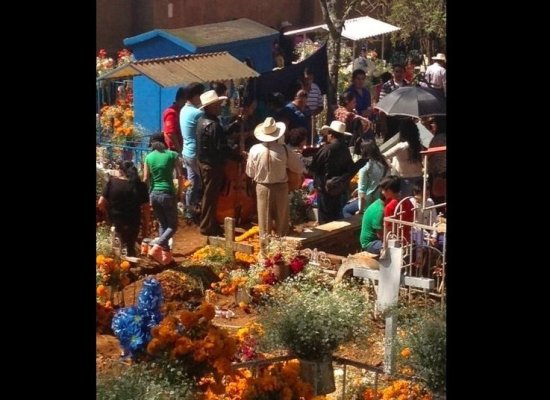
Once inside we saw families gathered around their dearly departed in the soft glow of candlelight. Altars were erected to honor those who'd gone before, graves decorated with sugar skulls, pan de muerto in hand-woven baskets covered in cloth napkins, and tall white candles in terracotta holders painted black -- wax dripping down like a pieces of art. Amber incense burned alongside gorgeous orange and hot pink flowers as relatives sat expectantly in hopes that their loved ones would return -- enticing them with their favorite meals, and with vices, cigarettes and liquor and personal effects. Some were grieving alone or together, praying and sitting quietly, while others laughed and drank, sharing stories of the deceased.
Old women wrapped in handmade shawls, the stories of their hard-working lives in the sun written across their faces, were mixed with young husbands who had lost their wives, parents mourning children and children mourning parents. They were all waiting for their deceased to return.
The sights and sounds of Dia de Muertos were something I couldn't have imagined in my wildest dreams. The whole city, celebrating and mourning those who'd gone before them and coaxing their return. Each display was a showing of family pride and not one grave was left untouched. It was all so loving, celebratory and elaborate. It reminded me that we are all part of something, part of each other.
Those few days taught me a lot about how much a part of life death truly is. It gave me a new tradition, which I will now celebrate in my own home with a decorative altar every year adorned with pictures of my grandparents and friends gone too soon. Most of all, being there taught me that you are never really gone as long as you are remembered.
Get updates on the President of Mexico, Enrique Peña Nieto, from the presidential website.
As the lights from Janitzio came into view through the night sky the anticipation was palpable. The boat anchored among lily pads and murky water.
 |
| Boy at grave. Image source: HuffingtonPost.com |
I'd been to Mexico before to promote my books but mostly in the bigger cities -- Monterrey, Guadalajara, Mexico City. This time was different. After a long week of interviews and signings, my publisher Alfaguara rewarded me with a road trip to Pátzcuaro, a town in the state of Michoacán, founded sometime in the 1320s. Or, as I like to call it, the ground zero of Dia De Muertos, a traditional holiday observed each November 1 (All Saints Day) and November 2 (All Souls Day). After writing about Day of the Dead in my latest ghostgirl novel, what a thrill it was to see it firsthand, to experience the sights, sounds, and tastes of it all.
Our day began with a breakfast of coffee and pan de muerto -- the delicious, traditional bread with bones made of dough on top. Then we headed into town for a long hike. My editor Atu suggested we see the lake that we'd be crossing that night along with the three islands that were infamous for their graveyards and Dia de Muertos celebrations. The biggest island, Janitzio, was the one we were set to visit. It was a breathtaking a view from the mountaintop, to see the lake and the islands from afar before setting sail to actually experience it. That night, we boarded the boat for an hour-long voyage to the Janitzio.
 |
| Band on the grave. Image source: HuffingtonPost.com |
At around 10:00 p.m. we walked down towards the water and passed through the gates of the harbor, adorned with bright orange cempasúchil flowers thought to attract the spirits from the other side. Posthumous family portraits, many over a hundred years old, lined the walkway. Infants and their mothers who died in childbirth were propped up on wood pegs as if they were alive. Young women, babies, and children were dressed up in gorgeous gowns, imitating life, put on display for memories' sake. November 1st is the day devoted to the remembrance of children that have passed, and the images of deceased young ones was stunning and moving in a way I wasn't completely prepared for as we made our way to the cemetery.
Once inside we saw families gathered around their dearly departed in the soft glow of candlelight. Altars were erected to honor those who'd gone before, graves decorated with sugar skulls, pan de muerto in hand-woven baskets covered in cloth napkins, and tall white candles in terracotta holders painted black -- wax dripping down like a pieces of art. Amber incense burned alongside gorgeous orange and hot pink flowers as relatives sat expectantly in hopes that their loved ones would return -- enticing them with their favorite meals, and with vices, cigarettes and liquor and personal effects. Some were grieving alone or together, praying and sitting quietly, while others laughed and drank, sharing stories of the deceased.
Old women wrapped in handmade shawls, the stories of their hard-working lives in the sun written across their faces, were mixed with young husbands who had lost their wives, parents mourning children and children mourning parents. They were all waiting for their deceased to return.
 |
| Janitzio. Image source: HuffingtonPost.com |
Those few days taught me a lot about how much a part of life death truly is. It gave me a new tradition, which I will now celebrate in my own home with a decorative altar every year adorned with pictures of my grandparents and friends gone too soon. Most of all, being there taught me that you are never really gone as long as you are remembered.
Get updates on the President of Mexico, Enrique Peña Nieto, from the presidential website.
Wednesday, October 9, 2013
REPOST: From Pemex To Retail, Mexico looking better
Despite contrary opinions, Mexico remains attractive to foreign investment. Forbes.com’s Kenneth Rapoza peers behind the curtain of Mexico’s economy to reveal a country that, despite its ups and downs, is poised to become a big player in the world stage.
More updates on President Enrique Peña Nieto and his projects for Mexico are available on the Mexican Presidential Website.Despite its lackluster performer this year, Mexico is still a favorite investment for Latin America-bound emerging market fund managers. And on Monday, investors were given another reason to like this country.Retail sales rose 1.3% year over year in July. The headline retail sales index posted a stronger expansion than consensus, which was 0.5%. In seasonally adjusted terms, Mexican retail sales rose 0.6% month over month, also above than consensus.The surprise of Mexico’s retail performance is due to general goods same-store sales (SSS) declined 4.7% in m/m sa in July, while consumption imports also contracted 1.7% m/m sa in that month.Five out of eight sectors posted monthly gains within retail and within that universe, automotive did best. Car sales were up 2.7% on the month. Healthcare, supermarket and department store sales increases made up for declines in food and clothing drops.
Image Source: www.hexell.livejournal.com Besides today’s retail sales data, investors are getting more upbeat about Mexico’s leader, Enrique Peña Nieto.Mexico is introducing some new reforms to increase competitiveness. One the market is most excited about is in the the energy sector. Right now, government oil giant Pemex rules the land and sea when it comes to oil and gas. Nieto wants to invite others to give Pemex a hand. So far, he has had a couple of successes in the government, which suggest entrenched interests inside Pemex may be coming around, albeit slowly, to his line of thinking.
Image Source: www.cnsnews.com Key figures are taking his side. Pemex CEO Emilio Lozoya Austin said in August that if the government fails to reform its energy policy, Mexico could become an oil importer as soon as 2015.For now, the Constitution of Mexico reserves the natural resources for the people of Mexico, so it prevents foreigners from coming in and developing oil reserves. That work all falls on Pemex. The investment in oil and gas equipment and exploration all end up being a big burden on Mexico’s fiscal accounts. Plus most of the profits of Pemex go to the government and that leaves them less money to re-invest in oil production.Peña Nieto would like to take more of a Brazil approach to its oil reserves than a Venezuelan one. Even though Petrobras is the kingpin of Brazilian oil, multinationals are allowed bigger stakes in Brazil’s oil wealth.
Image Source: www.mnn.com “Mexico needs to broaden out their tax base,” said Marc Tommasi, managing director and head of international investment strategy at Manning & Napier in Rochester, NY. “Mexico is still a big oil derivative play. And that story has been tougher to sell in recent years because the production profile has been deteriorating so rapidly. It’s getting critical and they need to do something soon,” he said.Higher car sales means more demand for fuel in Mexico.Mexico is looking better. Peña Nieto is one reason. A stable U.S. is another. Any upside to the U.S. economy is an added bonus for Mexico investors, Tommasi said.But investors are still taking a wait-and-see approach to confirm whether Mexican consumers can keep the economy growing. Retail sales have been generally stagnant throughout the year.August is looking up, said Marco Oviedo, a Mexico analyst at Barclays Capital in Mexico City.The resumption of government expenditures along with a better manufacturing performance should support employment growth too, helping to keep Mexico in the investor spotlight for the rest of 2013.


Thursday, September 19, 2013
Commemorating the friendship of two worlds: The Friendship Arch at Delhi
Mexico and India are states a hemisphere apart and share the same statuses as emergent economies in the world stage. The two have enjoyed a healthy friendship for some time and plan to commemorate this diverse microcosm of cultures through a shared monument that has waited a decade to be formally revealed.
In 2013, the monument, the Friendship Arch at Delhi, has finally been inaugurated. Erected at the Park of the Five Senses close to India’s historic capital, the structure was described as a people’s project, spearheaded by organizations like the Indian National Trust for Art and Cultural Heritage.
 |
| Image Source: www.bharatdarshan.info |
The monument, more than ten years in the making, is a corbelled archway, a replica of the Gateway of Labna in Mexico’s Yucatan State, a monumental sacred gate that served as a ceremonial passage among areas of the city. The gate is among the many enduring relics of the ancient Maya civilization, one of many pre-colonial civilizations and empires that dominated Mexico and Central America.
 |
| Image Source: www.boloji.com |
The arch’s inauguration took place on September 16th, Mexico’s Independence Day.
 |
| Image Source: www.mensxp.com |
This monument, more than ten years in the making, stands as a symbol of the enduring friendship between the two nations.
Get more updates on Enrique Pena Nieto, President of Mexico, from the Mexican Presidential website.
Subscribe to:
Posts (Atom)