More updates on President Enrique Peña Nieto and his projects for Mexico are available on the Mexican Presidential Website.Despite its lackluster performer this year, Mexico is still a favorite investment for Latin America-bound emerging market fund managers. And on Monday, investors were given another reason to like this country.Retail sales rose 1.3% year over year in July. The headline retail sales index posted a stronger expansion than consensus, which was 0.5%. In seasonally adjusted terms, Mexican retail sales rose 0.6% month over month, also above than consensus.The surprise of Mexico’s retail performance is due to general goods same-store sales (SSS) declined 4.7% in m/m sa in July, while consumption imports also contracted 1.7% m/m sa in that month.Five out of eight sectors posted monthly gains within retail and within that universe, automotive did best. Car sales were up 2.7% on the month. Healthcare, supermarket and department store sales increases made up for declines in food and clothing drops.
Image Source: www.hexell.livejournal.com Besides today’s retail sales data, investors are getting more upbeat about Mexico’s leader, Enrique Peña Nieto.Mexico is introducing some new reforms to increase competitiveness. One the market is most excited about is in the the energy sector. Right now, government oil giant Pemex rules the land and sea when it comes to oil and gas. Nieto wants to invite others to give Pemex a hand. So far, he has had a couple of successes in the government, which suggest entrenched interests inside Pemex may be coming around, albeit slowly, to his line of thinking.
Image Source: www.cnsnews.com Key figures are taking his side. Pemex CEO Emilio Lozoya Austin said in August that if the government fails to reform its energy policy, Mexico could become an oil importer as soon as 2015.For now, the Constitution of Mexico reserves the natural resources for the people of Mexico, so it prevents foreigners from coming in and developing oil reserves. That work all falls on Pemex. The investment in oil and gas equipment and exploration all end up being a big burden on Mexico’s fiscal accounts. Plus most of the profits of Pemex go to the government and that leaves them less money to re-invest in oil production.Peña Nieto would like to take more of a Brazil approach to its oil reserves than a Venezuelan one. Even though Petrobras is the kingpin of Brazilian oil, multinationals are allowed bigger stakes in Brazil’s oil wealth.
Image Source: www.mnn.com “Mexico needs to broaden out their tax base,” said Marc Tommasi, managing director and head of international investment strategy at Manning & Napier in Rochester, NY. “Mexico is still a big oil derivative play. And that story has been tougher to sell in recent years because the production profile has been deteriorating so rapidly. It’s getting critical and they need to do something soon,” he said.Higher car sales means more demand for fuel in Mexico.Mexico is looking better. Peña Nieto is one reason. A stable U.S. is another. Any upside to the U.S. economy is an added bonus for Mexico investors, Tommasi said.But investors are still taking a wait-and-see approach to confirm whether Mexican consumers can keep the economy growing. Retail sales have been generally stagnant throughout the year.August is looking up, said Marco Oviedo, a Mexico analyst at Barclays Capital in Mexico City.The resumption of government expenditures along with a better manufacturing performance should support employment growth too, helping to keep Mexico in the investor spotlight for the rest of 2013.
Showing posts with label development. Show all posts
Showing posts with label development. Show all posts
Wednesday, October 9, 2013
REPOST: From Pemex To Retail, Mexico looking better
Despite contrary opinions, Mexico remains attractive to foreign investment. Forbes.com’s Kenneth Rapoza peers behind the curtain of Mexico’s economy to reveal a country that, despite its ups and downs, is poised to become a big player in the world stage.


Friday, August 30, 2013
REPOST: Mexico: Surprising Land Of Opportunity
Mexico has a stable and growing manufacturing base that is being augmented by investments from developed countries like its northerly neighbor the United States. Shelley K. Schwartz of CNBC suggests that manufacturing is Mexico’s biggest trump card.
Snuffing out organized crime, widely considered Mexico’s primary impediment toward development, had been one of the campaign platforms of President Enrique Peña Nieto in 2012. Visit the Mexican Presidential website for the status on his administration’s promised reforms.When General Motors, the largest automaker in the U.S., announced last year it would invest some $540 million to expand its plant in Toluca, Mexico, it joined a growing list of manufacturers seeking more bang for their production buck south of the border.
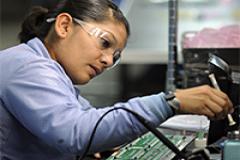
A worker solders components at the Suntron de Mexico assembly plant in Tijuana, Mexico.
Image source: cnbc.com
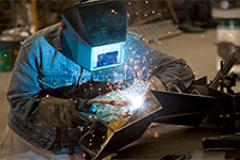
With lower shipping costs and increasingly competitive wages, Mexico is enjoying a manufacturing boom, attracting billions of dollars in foreign investment from firms that are building factories to supply the North American market — a concept known as nearshoring.
Most recently, automakers Nissan, Audi, Honda and Mazda have all announced plans to open plants in Mexico over the next few years.
Italian tire maker Pirelli & C. said earlier this year it would invest $300 million in new factories in Mexico by 2015, and Swedish appliance maker Electrolux moved a plant last year from Webster City, Iowa to Juarez, Mexico.
Blue-chip aluminum producer Alcoa also expanded its facility in Acuna, Mexico, joining U.S. companies already producing there, such as General Electric, Honeywell, and Hawker Beechcraft.
The influx shows no signs of abating.
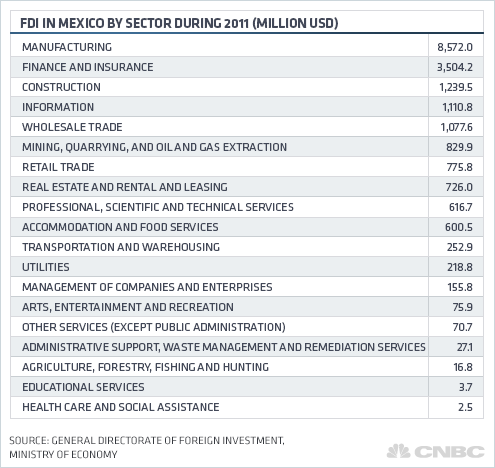
Foreign direct investment, or FDI, in Mexico reached $19.4 billion in 2011 — with nearly half of that total destined for the manufacturing sector, according to the Mexican Ministry of the Economy.
Image source: cnbc.com
Mexico's Allure
For manufacturers, much of the appeal is lower labor costs, says Gordon Hanson, director of the Center on Emerging and Pacific Economies and economics professor at the University of California, San Diego.
“Until very recently, China had been cheaper, more flexible and more accommodating to industry, but wages in China are rising at a remarkable clip, putting cost pressure on manufacturers,” he said. “Mexico didn’t start to win the battle against China until we started the recovery from the recent recession.”
Indeed, the average salary for Mexican workers was $2.10 per hour in 2011, up 19 percent from $1.72 in 2001, according to HSBC.
By comparison, the average wage in China swelled nearly four-fold during those years to $1.63 per hour in 2011 from 35 cents per hour in 2001. Thus, the difference between labor costs in Mexico and China is now just pennies per hour.
There’s also, of course, the cost advantage of proximity, notes Gabriel Lozano, J.P. Morgan’s chief economist for Mexico.
With higher fuel prices, he says, manufacturers worldwide are seeking opportunities to manage shipping costs by producing goods close to their market.
Today, it costs roughly $5,000 to ship a container from China to the U.S., compared with $3,000 to truck the same freight in from Mexico, says Lozano.
“We expect that trend to continue and build into 2013 and 2014,” he said.
The next manufacturing superpower?
Add to that benign inflation, modest salary growth, a compatible business culture, and faster speed to market, and some suggest Mexico is well on its way to becoming the next manufacturing superpower.
Despite widely publicized security risks stemming from the drug wars, the survey revealed another 43 percent of companies considering offshoring their existing U.S. operations also indicate Mexico is their top choice, with China at 30 percent in second place.
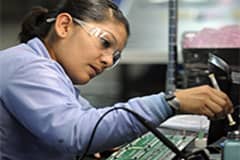
A worker solders components at the Suntron de Mexico assembly plant in Tijuana, Mexico.
Image source: cnbc.com
“With manufacturing exports growing at current rates, we expect Mexico to displace China as the top U.S. trading partner by 2018, as China’s labor cost advantage shrinks,” Martin said in the HSBC report.
Auto and Aerospace
Thus far, the automotive sector has generated the largest share of foreign investment in Mexico among manufacturers, representing 28 percent of total manufacturing exports, or 7 percent of gross domestic product.
“Manufacturing and, in particular, production of automobiles was the key driver of growth, with production of cars soaring in the first half of the year and data for July showing a faster expansion — almost 18 percent, and higher exports explain this growth, in turn, fueled by higher demand from the U.S.,” the HSBC report stated.
Mexico is also the world’s first exporter of refrigerators and the second-largest supplier of electronic products to the U.S. market.
But perhaps the biggest potential for growth lies in the aerospace sector, which has been growing more than 20 percent a year since 2004, according to the Mexican Association of the Aerospace Industry.
More than 260 aerospace companies now operate in Mexico, exporting $4.3 billion in aircraft and parts in 2010. That figure is projected to reach $12 billion by 2020, according to the association.
Major U.S. aerospace companies with operations in Mexico include Honeywell, General Electric, Cessna Aircraft, Hawker Beechcraft and Gulfstream Aerospace.
Canadian company Bombardier, maker of high-end business aircraft, French helicopter maker Eurocopter, and Netherlands-based Fokker also produce parts below the Rio Grande.
Investor Strategy
Investors looking to capitalize on Mexico’s manufacturing boom, however, should take heed, says Bill Rocco, senior analyst for mutual fund-tracker Morningstar, who covers emerging markets.
While the emerging markets have benefited greatly from elevated economic growth, individual stock picks within these countries are often more risky due to currency fluctuations, volatility and lower liquidity. (More:Latin America's Export Engine and Stock Juggernaut)
Plus, he notes, fund managers have most likely already spotted any companies that show promise, thus its potential is already priced into the stock.
“It depends upon the sophistication of the investor, but the idea that individual investors will get there ahead of the curve seems extremely unlikely,” said Rocco.
Modest exposure to emerging markets is important for all long-term investors, he notes, given the projections for growth, but many already have adequate indirect exposure through mutual funds that own large cap international firms that derive a significant portion of their revenue from the developing world.
A few emerging market mutual funds that Morningstar favors include T. Rowe Price Emerging Markets Stock Fund , Oppenheimer Developing Markets Fund , and American Funds New World Fund , which focused on large cap stocks like Nestle and Samsung that derive a significant portion of their revenue from emerging markets.
Rocco also likes Harding Loevner Emerging Markets Portfolio Advisor Class, which is not yet rated by his company.


Subscribe to:
Posts (Atom)